
Discover how AI-powered composable CMS architecture helps modern enterprises scale content operations, improve personalization, streamline workflows, and deliver seamless digital experiences across healthcare, finance, and ecommerce platforms.
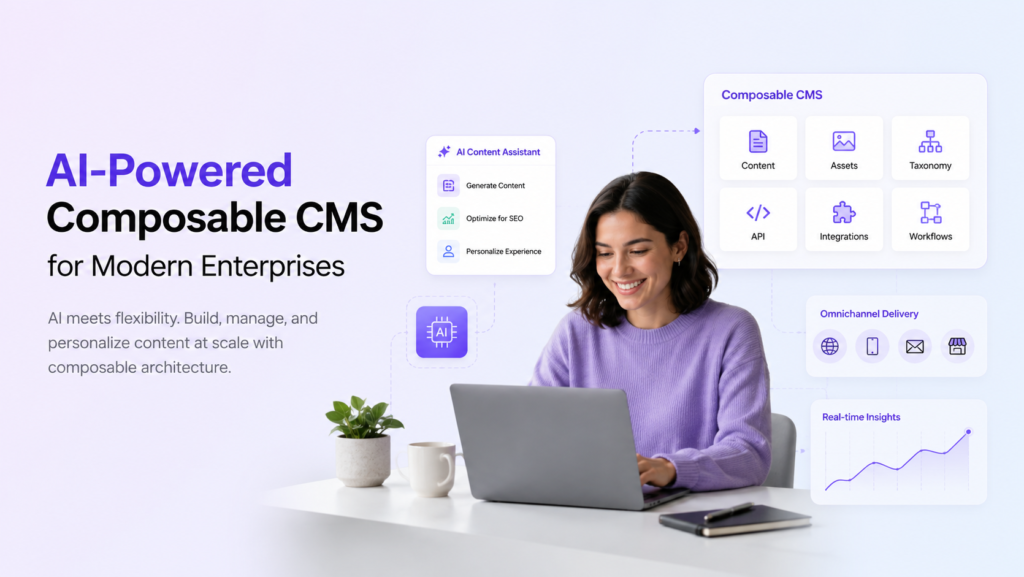
Table of Content
Modern enterprises are under constant pressure to deliver faster digital experiences across websites, mobile apps, patient portals, ecommerce platforms, and internal systems. Traditional CMS platforms often create development bottlenecks, limit scalability, and make personalization difficult.
This is where AI-powered composable CMS architecture is transforming enterprise digital ecosystems.
A composable CMS allows businesses to build modular, API-first content systems that integrate seamlessly with frontend frameworks, CRM platforms, automation tools, analytics systems, and AI-powered personalization engines.
At Accelaronix, we help enterprises design scalable composable content systems that improve performance, accelerate content operations, and deliver personalized digital experiences.
A composable CMS is a modern content management approach where different technologies work together as independent services instead of relying on a single monolithic platform.
Unlike traditional CMS systems, composable architecture allows enterprises to:
Composable CMS solutions are particularly valuable for industries like healthcare, finance, SaaS, and ecommerce where speed, security, and personalization are critical.
AI is becoming a major component of modern enterprise CMS systems.
AI helps businesses dynamically personalize content based on:
This improves conversion rates, engagement, and customer retention.
AI can automate repetitive editorial tasks such as:
This reduces operational workload while improving publishing speed.
Modern AI-powered search systems use semantic search and natural language processing to provide users with highly relevant results.
This is especially useful for:
Composable systems allow development teams to work independently across services and frontend applications.
This reduces deployment bottlenecks and accelerates feature releases.
Enterprises can scale only the services they need instead of scaling an entire monolithic platform.
Decoupled architectures reduce attack surfaces and improve infrastructure flexibility.
Content can be delivered consistently across:
Headless frontend architectures improve Core Web Vitals, SEO performance, and user experience.
Industries like healthcare and finance require highly secure and scalable digital platforms.
Composable architecture helps these industries:
Healthcare providers can use composable systems for:
Financial institutions can implement composable systems for:
Traditional CMS systems often struggle with:
Composable platforms solve these challenges by providing flexibility, modularity, and API-driven development.
The future of enterprise content management will focus on:
Businesses that adopt composable and AI-driven architectures today will gain a major competitive advantage in the coming years.
AI-powered composable CMS platforms are redefining how enterprises build digital experiences.
Organizations that invest in composable architecture benefit from faster development, improved personalization, stronger scalability, and better long-term flexibility.
At Accelaronix, we help businesses engineer modern composable CMS solutions tailored for enterprise growth.
Work With Us
Talk to our team and get a free strategy review tailored to your goals within 48 hours.
Book a Free Consultation